Brutus of Troy Was Here

There was nothing cold about it.

The vitality in its veins

moved in time

with my blood pressure.


It was always so.


There was fire within its walls

from the start,

since the first sod was turned.


It flows all night.

There were ashes glowing

as I flew in and slipped back to nest

inside the city

where strangers become mates.

It will be told.

There’s a world washed by fresh water

flooded by émigrés from Earth.

O River Thames,

tributary,

you’ve nourished us all.

I left my soul behind

I went abroad in Moanbaun woods last nightThe air was crispy sharp and stars alight
Out of the shadow of an old oak tree
stumbled a tall figure following me.
‘ You’ve left your soul behind your back’ she groaned
‘That weight you bore from birth and never owned
it cost a fierce fortune to germinate
and raise from seed divine now rests in state.’ Underground, earthworms slept on roots below
surface, undisturbed by an angel’s flow.
My body freed from care in time for life
Immortal pest intestate cast without a strife. So all I crave and relish on this crust
is Liberty that rises from the dust.

Pick up thy pen

Pick up thy pen

and run

fingers over paper.

Feel the lines,

they crave your attention.

They deserve your touch.

They will suck the ink from your nib.

I promise

you will come

on the page

and wonder

‘How was that for you’.

Grace

The poem read by the poet

She came – like a story – into words
from roots planted deep in the womb of her mother’s mystery.

She came – like a foal – from that womb,
a filly full of windswept curls.

She crawled on kitchen floors – between legs of chairs –
until she stood steady and strode past barricades and cant.

She rode her way into her biography
on ponies that foostered – she put manners on their stride.

She carries the weight of her imagination on her back
every morning – on her way to school.

Are you awake?

I

“Is anyone awake?” said the man in his kitchen.

Is there anybody out there

whose eyes, however brittle, are awake?

Is there anyone there for me?

Is there anyone I can’t see?

II

What about the people across the ocean?

What about the people across the land?

What about the people by the lakeside,

are they all sleeping?

When will they wake?

When will they rise?

Like Lazarus, or like their sleeping dog?

III

Yes, who are these people

who are awake and are not speaking?

Are they there for me?

Do they have any way to see the difference they make,

the meanings they build,

the hours they swill?

IV

It’s time for tea,

the kettle, she boils.

The bag has been thrown in.

My cup is not empty.

The chemistry is about to begin.

V

Who is asleep?

If you are asleep, may you be woken.

If you are awake, may you sleep.

You may be in the dark
ears perked
listening for the commas

There may be wax
earwigs
waiting to soften and fall

Are you still?
your eyes locked?
doorway rusted overnight

When will you ever earn

the flowers in your ears?

Graveyards are singing,

welcome the sound of dawning insight,

clasp the stave of whispering shadow.

Enter the Beast

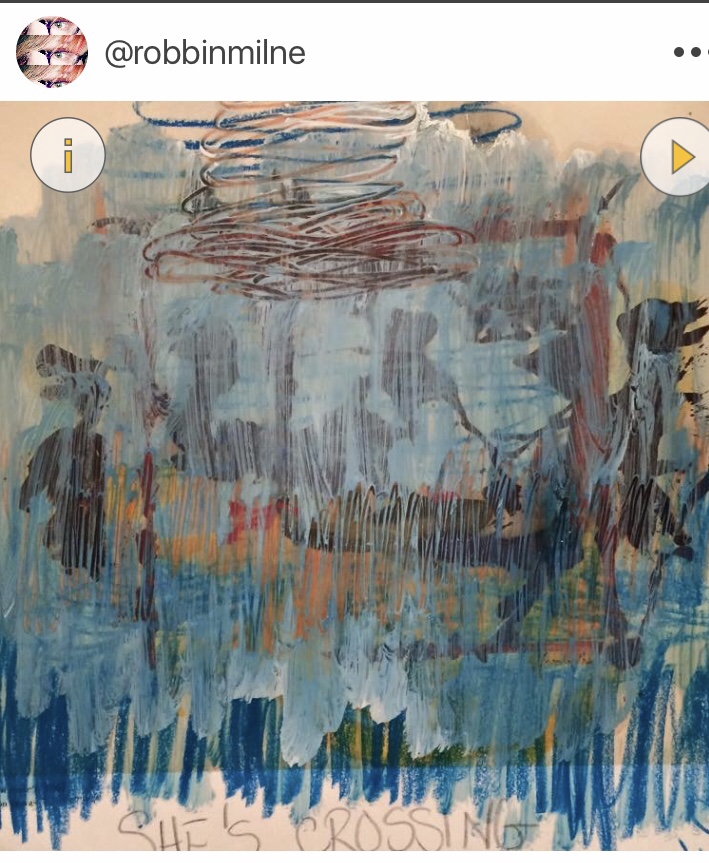
She’s crossing muddy waters (song lyrics)

[In honour of Robbin T Milne, painter]

Hang up, hang up

Your summer brushes,

Your daytime rushes

Your morning blushes

Hang up, hang up

She’s crossing muddy waters

Going out on the tide

She is crossing muddy waters

Heading for the other side

Because she has to earn her living

Needs more food to keep her going

The paint, it doesn’t come free

Her paintings don’t grow on trees

Hang up, hang up

Those summer brushes,

Your daytime rushes

Those morning blushes

Hang up, hang up

She’s crossing muddy waters

Hanging out upon the sand

She’s crossing muddy waters

She knows you’ll understand

Because her shoes have all worn thin

And her makeup’s all run dry

You know she’ll never win

Until she can afford to cry.

Hang up, hang up

Your summer brushes,

Your daytime rushes

Your morning blushes

Hang up, hang up

She’s crossing muddy waters

Wading through a cotton field

She’s crossing muddy waters

She’ll never ever yield

Because her eyes are losing light

The glass cracked and out of date

You’ll see her virtigo

And always running late

Hang up, hang up

Those summer brushes,

Those daytime rushes

Those morning blushes

Hang up, hang up …

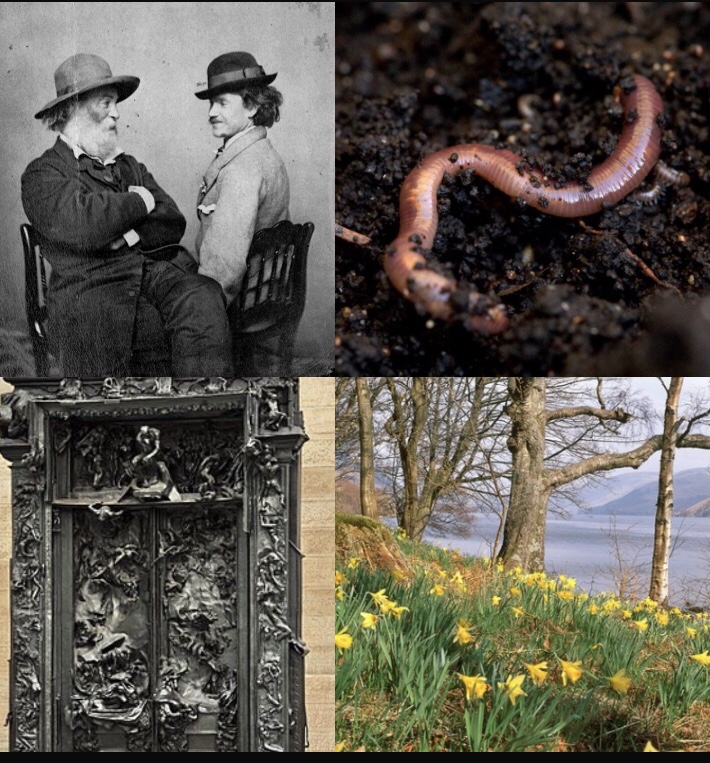
Did Wordsworth capture daffodils?

Did Wordsworth capture daffodils the way bees in my garden capture nectar?

Did DaVinci capture Mona Lisa’s smile the way black birds capture earthworms?

Did Rodin capture the Gates of Hell like Elton John captured Candles in the Wind?

Was Abelard accurate when he said Heloise captured his heart?

And what about Dante’s Beatrice – was anyone captured?

Did my lover capture me?

Have I captured my love?

The way my earthworms capture …

The way Ansel Adams captured Yesemone

And Walt Whitman captured America.

Have you captured anything recently?

A poem in my pocket

I have a poem in my pocket called itch.

It doesn’t have a name, and it certainly doesn’t have a first or last line.

For all I know it might be an epic, or an epigram.

I don’t know when it’s going to come out, when it will reveal its proclivities, what it’ll mean to my grandchildren.

If it collapses, I don’t know how I will feel.

If it turns into a cancer, I don’t know what I’ll do about it.

I don’t think there is a cure – but there might be a remission.

Louis is an English Setter, probably failed his training as a gundog.

Someone gave him to a rescue centre in Cork. All he wants is attention.

He’s a bit of an itch.

He might be the hero of the poem.

My father

My father was a lion.

When he was napping,

I relaxed into hitting golf balls

over the house,

with a wedge.

When he woke up,

he drank Bewley’s coffee

in the kitchen,

in front of the Aga.

He’d been shot with a bullet

in the left shinbone

by a sniper,

from the roof of Cleve’s Factory,

across the Shannon River

in 1921.

My father didn’t limp,

he wore brown brogues,

grey socks, and an Omega.

He was born before Fathers’ Day.

When I was young,

every day was mother’s day:

she wrote the rules,

he approved.

His drawing room game was chess,

his golf game twice a week,

followed by hands of forty-five.

I was his caddie.

He paid two and six pence,

and a bottle of orange lemonade.

Dad was a Chopin man

with straight-back hair,

his forehead marked

from the day a surgeon

drilled into his scull,

and he lost his sense of taste.

He shaved with a cut-throat,

wore cuff-links

and turned shirt collars

in the old days,

before I was born.

His scapular was Franciscan,

from the Third Order.

He insisted on accurate light readings

for family photographs,

his Leika was slow.

Dublin was “the Big Smoke”

where he bought pipes.

What was the name of the plug tobacco?

He recited “Dangerous Dan McGrew”,

“The Hound of Heaven”

and decades of the Rosary.

My father was a Pioneer,

drove a Ford Capri

for a year,

carried cash to the Munster & Leinster,

and ate tripe on Fridays.

My father, carnivore,

carved the meat.

He made sure

we all got second helpings.

Rebecca from Wanderlust

I went walking with Rebecca
in Moanbaun Wood,
until I lost her.

People passing by
haven’t seen Rebecca
for half a year.

I miss her way
of walking,
and talking to her.

The thing I loved about Rebecca
is that she was deaf
to me.

But I always felt
she could understand me.
She was great company

underneath the birds,
passing puddles,
greeting gorse,

praising pines.
I saw she had her way of
walking streets.

We strolled in gardens,
went with Wordsworth
up the mountains.

I remember meeting Kierkegaard.
Rebecca Solnit spoke of the arrival
of bipedalism,

and pilgrimages.
I have this niggling feeling
she’ll come back,

I’ve even made a resolution,
if she’s not willing to reappear,
I shall reappear her.

I’m not contemplating
separation or divorce,
she has too many children for that

I couldn’t possibly abandon them.
There’s a cabbage white
fluttering above

the roots of a spruce.
I spy cut logs, alongside
trunks stripped of branches,

and my dog run ahead.
If only Rebecca was here,
I would talk with her.

I would hold her, in my arms,
with fingers, holding tight,
with my tongue, ever so close to hers

There’s nothing like an intimate walk,
where, every few steps,
you get excited again.

Thrush sing at the thought of her,
down there,
where the stream flows

under beech trees,
where streaks of sunlight cut through.
I don’t think Rebecca’s there.

I think she’s still living with me,
and will again
welcome my friends to a wander in woods.

That’s Rebecca’s track record.

Two childhoods

I didn’t have much of a life as a kid,

all I did was climb trees,

collect eggs from the hens,

make bows and arrows,

eat poison mushrooms

slam windows and kick football,

hook Berberis thorns to an arrow,

hit golf balls over the house.

There wasn’t much in my life,

I hadn’t anything else to do.

2

But now, with my own children,

I’m going to ride horses with them

I’m going to go to the cinema with them,

I’m going to get married with them.

They’re going to be close to me,

so close I won’t go anywhere without them.

They’re going to have an excited life,

they’re going to be so pleased

I want to be by their side.

They’re not going to have a childhood like I had.

Do poets write enough prose?

I don’t,

plus

I don’t know enough poets.

I’m not wondering whether poets write enough literary criticism, or study notes for creative writing students.

I’m asking myself which poet writes about Donald Trump, the decline of fish stocks, the discovery of new species on an island in Indonesia, and the like?

Do poets write crime novels, editorials for newspapers, even travel books?

Which poet is an undertaker – apart from Thomas Lynch?

I’m reading a book that’s out of date. “Can Poetry Matter?”

– essays on Poetry and American Culture” by Dana Gioia (a man).

I’m borrowing ideas he first shared in 1991.

I paraphrase what he said: the state of poetry in America is wretched.

Things have changed, Dana says recently. In the introduction to the 10th anniversary edition, he says things have got better. Poetry is no longer in the grip of an academic monopoly.

There are now countless poetry festivals, book fairs, reading series, discussion groups, and conferences based in the community rather than the academy.”

I started writing poetry in 1995. I’m not steeped in the poetry of others.

I can’t judge what the poetry scene is like on this side of the Atlantic, let alone Ireland.

But I can do a bit of research.

Are Irish poets earning their living teaching poetry in educational institutions?

Who are the best known living Irish poets?

  • Evan Boland
  • Brendan Kennelly
  • Ciaron Carson
  • Paul Muldoon
  • Eiléan Ní Chuilleanáin
  • Medbh McGuckian
  • Nuala Ní Dhomhnaill
  • Gerald Dawe
  • Theo Dorgan
  • Paul Durcan
  • Sean Dunne
  • Kerry Hardie

Michael Longley

born 27 July 1939) is from Belfast in Northern Ireland. the Ireland Professor of Poetry from 2007 to 2010, this being a cross-border academic post set up in 1998.

Derek Mahon

born 23 November 1941) was born in Belfast, Northern Ireland. After leaving the Sorbonne in 1966 he worked his way through Canada and the United States. In 1968, while spending a year teaching English at Belfast High School, he published his first collection. He later taught in a school in Dublin and worked in London as a freelance journalist. He currently lives in Kinsale, Co. Cork

Paula Meehan

“born in Dublin 1955, moved to London. Returned to Dublin.

expelled for organising a protest march against the regime of the school. Outside school she was a member of a dance drama group, became involved in band culture and, around 1970, began to write lyrics. Gradually composing song lyrics would give way to writing poetry.

At Trinity College, Dublin, (1972–77) she studied English, History and Classical Civilization, taking five years to complete her Bachelor of Arts degree. This included one year off, spent travelling through Europe. While a student she was involved in street theatre and various kinds of performance.

After college she travelled again, spending long stretches in Greece, Germany, Scotland and England. She was offered a teaching fellowship at Eastern Washington Universitywhere she studied (1981–83) with James J. McAuley in a two-year programme which led to a Master of Fine Arts degree in Poetry. Gary Snyder and Carolyn Kizer were among the distinguished visiting writers to have a profound influence on her work and on her thought.[1]

She returned to Dublin in the mid-eighties. 

Meehan has also written poetry for film, for contemporary dance companies and for collaborations with visual artists; her poems have been put to music by songwriters (including Christy Moore) and composers.[2]

The 2015 Poetry Competition ‘A Poem for Ireland’ shortlisted her 1991 poem ‘The Statue of the Virgin at Granard Speaks’ in the final ten poems

Tom Paulin

born 1949 in Leeds, England – grew up in Belfast. While a teenager, Paulin joined the Trotskyist Socialist Labour League. He is a critic of film, music and literature. He lives in England, where he is the G. M. Young Lecturer in English Literature at Hertford College, Oxford.

Peter Sirr

born 1960 in Waterford, Ireland. He lives in Dublin. He was director of the Irish Writers’ Centre from 1991-2002, and editor of Poetry Ireland Review from 2003-7. He works as a freelance writer and translator. He lectures part-time at Trinity College Dublin.

Joseph Woods

born 1966 in Drogheda, Ireland. He was an industrial chemist. Director of Poetry Ireland, the national organisation for the support and promotion of poets and poetry from 2001 to 2013. He now lives in Harare, Zimbabwe with his wife and daughter. He works as a writer and editor.

Paddy Bush

born in Dublin in 1948, lives in Waterville, Co. Kerry. He works as an editor and has curated the anthology Voices at the World’s Edge: Irish Poets on Skellig Michael (Dedalus, 2010)

Rita Ann Higgins Higgins

was Galway County’s Writer-in-Residence in 1987, Writer in Residence at the National University of Ireland, Galway, in 1994–95, Writer in Residence for Offaly County Council in 1998–99. She was Green Honors Professor at Texas Christian University, in October 2000. Other awards include a Peadar O’Donnell Award in 1989, several Arts Council bursaries ‘Sunny Side Plucked’ was a Poetry Book Society Recommendation. She was made an honorary fellow at Hong Kong Baptist University November 2006” (Wiki)

John F Deane

born 1943 on Achill Island, poet and novelist. He founded Poetry Ireland and The Poetry Ireland Review in 1979.” (Wiki)

—————–

Whom have I overlooked?

I’ll find about more of them when I have time (to be continued)
Mary Oliver read Lucretius

She was well enough to read and walk.

What exactly did she read? Lucretius wrote a lot.

Maybe he wrote about frogs dancing and herons at funerals?

I’ve heard it said Mary danced, out by a pond in her garden in Ohio.

She was natural, a youngster gestated by Mother Nature. With frogs and herons for siblings.

Mary saw the Roman’s sword in the beak of the heron that washed in her shining water.

After reading her poem, I know all this. As if I’m a biographer, historian, anthropologist, archaeologist, drinking tea in Café Beva.

I hope her friends danced in black at her funeral, the way she did after reading Lucretius.

———-

Note (1) In 54 BC, Cicero said: “The poems of Lucretius exhibit many flashes of genius, and yet show great mastership.”

Note (2) You’ll find “AFTER READING LUCRETIUS, I GO TO THE POND” in the slim collection “Blue Horse” (2014) by Mary Oliver RIP

Yer man David Attenborough


Screen Shot 2019-04-29 at 14.34.09

Not everyone strives to change the world
and leave it fit for children

You found this on your travels abroad
and when you looked around.

Not everyone cares enough to cry
when others squirm from hunger

You found this as you walked the streets
with ice-cream in your hand.

Not everyone cares we lost the dodo
and barbary lions are gone

You found this as you missed the cod
and oysters in the wild

Not everyone cares the sun will shrink
and Earth will die from heat

You found this as you picked plastic
and chucked it in the bin.

Not everyone fails to give a damn
and walks the other way

You met him on the television
thank goodness for that man.


Articulations

1.

A whisper:

“Shall I give her a name,

or leave her alone

with the name her parents wrote?”


To me, she is The Robbin,

a paintbrush for travellers,

a studio on two vastless legs

of berry-blood & mineral shavings


that stand inland

from the coast of north California,

most days,

these days.


This is a still life.

An abstract painting

that deserves more details

articulated.


Let me put a cat

– I call her The Molly Cat –

in the bottom left-hand corner,

next to The Book of Rilke,


inconspicuous,

the way Vermeer

placed his Geographer’s Globe

by latticed glass.


Today, I’m shoving a glistening damp canvas

out of the way

into the background

to show my subject’s still alive.


There’s more to this work of art.

This unfinished symphony

This half-arsed hommage

To My Robbin …

__________________________

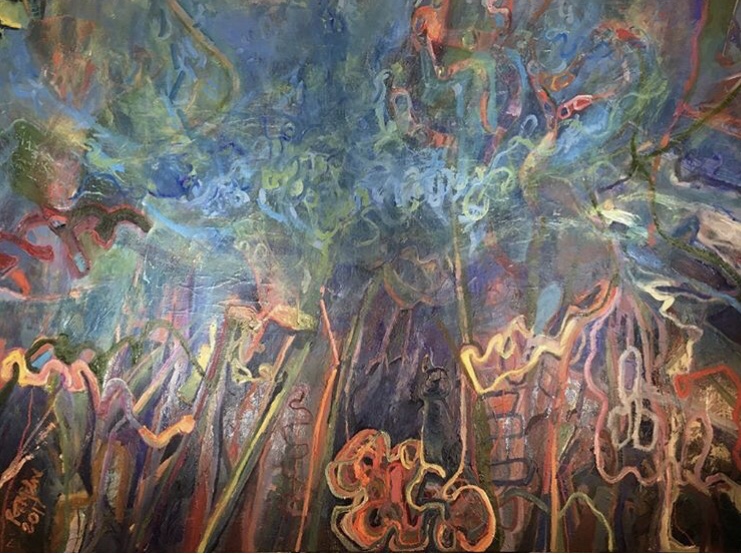
Note: The photo was taken by California painter and studio artist. Robbin T. Milne Dancing Denizens: In Search of Enki, 2017, Oil on Canvas, 60″x82″

The choice

Screen Shot 2019-04-21 at 18.59.41

“Take your choice.

We’ll strip you,

no matter what you choose.

Are you to be dragged through nettles for a thousand miles,

or to be pressed into gorse for a thousand hours?

Alternatively, you can confess your sins, now.”

The pilgrim smiled,

scratched his beard,

and smiled.

I confess that

I have sinned, uproariously,

I have basked in the glory of indecision,

I have procrastinated with aplomb.

I confess that,

in the face of pain,

in the armpit of shame,

in floods of indecency,

I have not made up my mind

about how to suffer.

Do with me as thou will’st.”

The Resurrection is coming: Easter 2019

img_2591

“It is time for the Resurrection,
Hibernation is not eternity”

Even a human being is entitled to wake up

without chocolate and haiku.

Ambiguity
introduces confidence
after Calvary

To rise from the dead at night,

well before dawn illuminates

bare tiptoeing feet of half-believers,

thrills me.


I am come from the other place,

where everything tastes

like raw, un-salinated olives.


I am come to be

in the presence of my redeeming

Landscapes

Seascapes

Mindscapes

Universcapes


I am company for an escaping spirit.


I am come for the fun,

a party to celebrate the Resurrection of the Word.

A sapling

A sapling stood,
blowing in the storm,
while a poet,
buffeted by a thunder of questions,
cut fingertips in crevices
edging along solid stone.

What’s your poetry like?
What do you write about?
What do your poems mean?
Are you published?

The composer stumbled
from stage to topsoil,
sand, silt, and clay,
strewn on limestone.

I am a translator.
missionary,

adventurer.

You ask me
What’s your sapling like?
How does it stand in storm and flood?
What does your frail growth eat for breakfast?
How taste’s your sap?

–  in a few words we’ll understand.

“And what’s more,
tell us the story of your conception:
What magic pollinated and fertilised you?
Who gave you seeds to throw,
and drew you towards the sun?
Where have you bloomed?
What has attracted you
to such a timely death?

– in words from which we can grow rich.

O Sleep you black hole

O Sleep, my lovely boy, that sucks all fragments
from stellar gas, and swallows time from where
the galaxy resounds, and thereby draws the stuff
of dreams in bondage deep to sweet mem’ry;
If Universe awards your constant love
of generating eyes that move beyond
the Pale of slumb’ring lids, I shall
open the stars you win as prize by night.
She watches all that moves in hearts sublime
and even chews the devil’s grandest scheme.
No matter how flat she lies waiting here,
she may abstain from tales of light, and song.
Her orbit, though retreating, will awake
your smile, and transport you for goodness sake.

___________________

With thanks to William Shakespeare, Sonnet 126